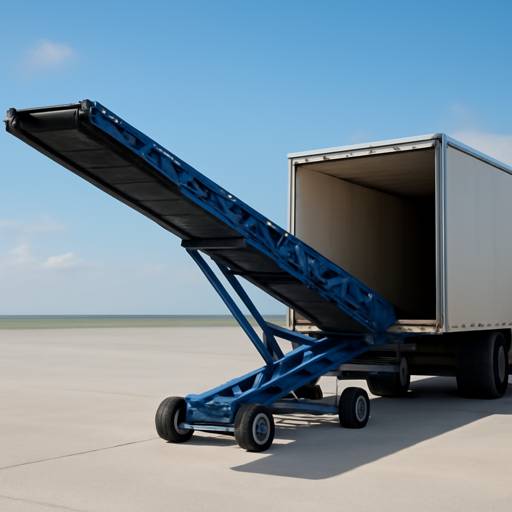
What Is a Telescopic Belt Conveyor and Why It Matters
A telescopic belt conveyor is a extendable, motorized boom that projects deep into a trailer or container, creating a fast, safe path for cartons, parcels, and loose items during truck loading and unloading. Unlike static dock belts, the telescopic sections extend and retract to match vehicle length and shift position as work progresses, so operators handle fewer steps and less lifting. The result is a direct flow of goods from staging to trailer and back again, with minimal manual handling and shorter turnaround times at the dock.
Modern units integrate variable-speed drives, soft-start motors, and intuitive controls so crews can dial in the right pace for fragile packages or high-volume parcel bursts. LED task lighting, emergency stops, and photo-eye sensors enhance visibility and safety inside dark trailers. Some booms add a hydraulic or articulating nose to reach floor-level cartons or high stacks without strain, and optional operator platforms keep team members at a consistent ergonomic height as the boom advances. With these capabilities, a telescopic belt conveyor becomes the ergonomic heart of high-throughput docks.
For operations where agility is vital—express parcel hubs, cross-border e-commerce, and fast-moving omnichannel warehouses—the difference is dramatic. Fewer forklifts are needed inside trailers, congestion eases at the dock face, and teams can clear peaks without adding headcount. In regions with dense logistics corridors and compressed delivery windows, engineering-led manufacturers have refined designs specifically for rapid changeovers, mixed truck sizes, and 24/7 duty cycles. Explore proven configurations and accessories tailored to these pressures with a single, streamlined link to telescopic belt conveyor for truck loading unloading, then align features to your dock profile, parcel mix, and labor model.
Crucially, telescopic systems scale. Facilities can begin with a single-stage boom for standard box vans, then advance to multi-stage units or a traversing base that services multiple doors as volumes grow. Because setup is modular and operator training is straightforward, many sites achieve quick wins: improved trailer cube, reduced non-value-added walking, and lower injury risk. Those gains compound when the conveyor connects upstream to sorters or pack-out lines, creating a continuous, low-friction flow from goods-to-person stations to outbound doors.
Key Features, Options, and Specifications That Drive Performance
Performance starts with the boom architecture. Single, double, or triple-stage frames extend reach from short vans to 53-foot trailers or high-cube containers. Heavy-duty steel sections with precision rollers ensure smooth travel even under sustained loads, while powder-coated finishes and sealed bearings deliver durability across humid or dusty environments. Belt widths are selected to fit parcel dimensions—wider belts for bulky items, narrower for smalls—to balance capacity with control. Variable frequency drives support gentle acceleration for fragile goods and faster speeds during parcel surges.
On the business side, the most valuable options are those that eliminate wasted motion. An articulating gravity roller or powered nose addresses height differences between dock and trailer floor. Auto-indexing keeps the discharge point a set distance from the carton face, continuously advancing as the trailer fills so workers remain in an ergonomic zone. A mobile, traversing base allows one unit to slide laterally and serve several adjacent doors, multiplying utilization without expanding footprint. Where docks are crowded, a compact retracted length and low stowed height free space for other equipment.
Controls and connectivity turn a truck loading and unloading conveyor into a smart workstation. A simple HMI with preset positions, local/remote speed control, and photo-eye accumulation mode supports different shifts and product types. Booms can exchange signals with warehouse management and control systems to coordinate start/stop with sorter batches or lane assignments. Integrations with scanners, dimensioners, and weighing devices near the boom tip enable real-time capture of shipment data, shrinking exceptions and improving billing accuracy without adding steps.
Safety and ergonomics are non-negotiable. Expect bright, glare-free lighting, anti-slip surfaces, protective skirting, and clearly placed E-stops. Photo-eyes at the infeed and discharge minimize contact incidents, while interlocks prevent motion when guards are open. Operator platforms and lift-assist devices reduce bending and twisting, helping crews sustain velocity over long shifts. Noise-reduction features and efficient IE3/IE4 motors, combined with regenerative braking on inclined sections, further improve work conditions and energy efficiency.
Maintenance design affects lifetime cost more than most realize. Look for modular belt assemblies, quick-change rollers, and accessible drive components to compress mean time to repair. Condition monitoring—via vibration, temperature, or current draw—predicts wear on bearings and motors so maintenance can be planned between waves. For facilities near coastal or high-humidity climates, corrosion-resistant materials and IP-rated enclosures protect electronics. Service kits, remote diagnostics, and clear documentation keep uptime high. Manufacturers focused on continual R&D since the late 2010s have particularly refined these elements for Asia’s fast-scaling parcel networks and industrial load/unload tasks, where every minute of dock time matters.
Real-World Applications, ROI, and Deployment Scenarios
Express parcel hubs live and die by turns per door. Here, a telescopic belt conveyor converts chaotic peaks into disciplined flow. Parcels are staged by route or carrier, then fed continuously into the boom. Inside the trailer, an operator builds stable walls with minimal walking because the discharge point stays close. Sites frequently report double-digit reductions in cycle time and fewer damages, thanks to smoother product handling and less stacking under pressure. In cross-border operations, where product mix swings from apparel to consumer electronics, variable speed and articulating noses let teams switch seamlessly without downtime.
E-commerce fulfillment centers across the Pearl River Delta, Shenzhen, Guangzhou, and beyond often contend with sudden promotional spikes. During major shopping festivals, docks can see volumes triple within hours. With telescopic equipment, supervisors spin up extra waves without reconfiguring the floor: the same boom that supported standard picks in the morning can extend into floor-loaded containers by afternoon. For manufacturers shipping industrial components, booms reduce forklift entries into trailers, lowering collision risk and insurance exposure while freeing lift trucks for heavier pallet moves elsewhere.
Quantifying ROI typically starts with labor and time. Consider a dock that manually loads 1,200 parcels per hour across two doors using four workers per door. A well-specified telescopic system often enables each door to maintain or lift that throughput with one fewer person, while reducing average trailer dwell time by minutes per load. Over a year, those labor hours and turns translate to meaningful savings and more shipping windows captured each day. Factor in reduced injuries and claims—owing to better ergonomics—and the payback period for many sites lands within a predictable 12–24 months, sometimes faster in round-the-clock operations.
Implementation is more practical than many expect. A site survey verifies dock height, door spacing, power availability, and traffic patterns. Floor-mounted bases suit retrofits, while pit-mounted units deliver minimal step height at the infeed. Where multiple carriers occupy adjacent doors, a traversing base unlocks maximum value. Commissioning includes operator training on safe use, speed selection, and simple daily checks. Preventive maintenance plans—monthly belt inspections, quarterly bearing checks, annual drive servicing—sustain performance without disrupting shifts.
Finally, think beyond the boom. Upstream, merge-infeed stations, smalls conveyors, or put-to-route sorters balance flow before items reach the telescopic belt. Downstream, some facilities pair the boom with mobile roller extensions or vacuum lift assists for heavier cartons. Data from scanners or WMS events can pace the conveyor, releasing product only when the trailer team is ready. This orchestration creates a reliable, end-to-end value stream from packing to door, aligning engineered equipment with people, processes, and peak calendars. In fast-growing logistics markets where innovation and trust define supplier partnerships, thoughtfully specified telescopic systems continue to be the keystone of safer, faster, and more resilient docks.